



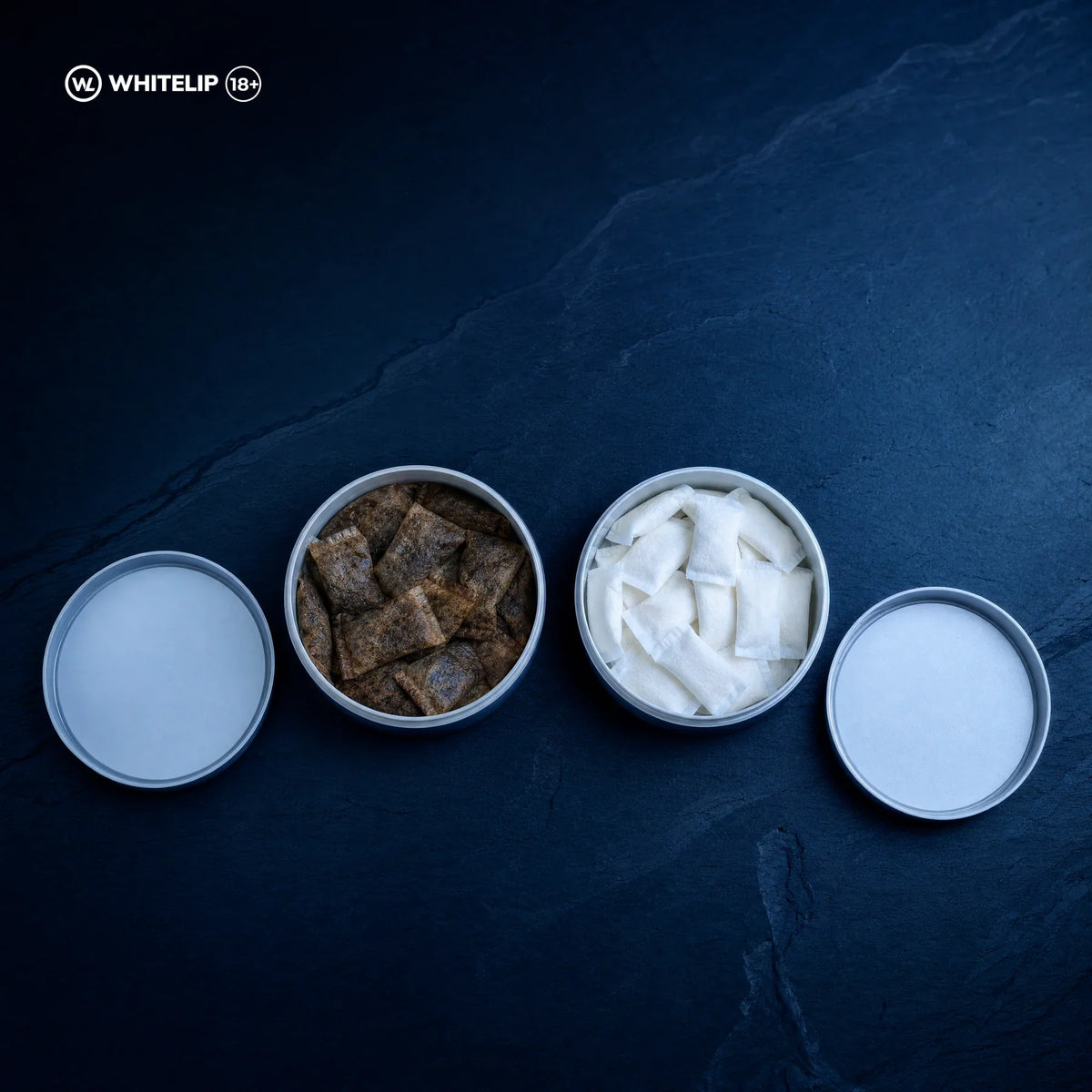
Traditional snus contains tobacco. Nicotine pouches contain nicotine in a filling without tobacco leaves. Similar containers and pouch shapes can make the products look alike, but their composition differs.
The main differences
| Feature | Traditional snus | Nicotine pouches |
|---|---|---|
| Main filling | A processed tobacco mixture | A filling without tobacco, often based on plant fibres |
| Nicotine | Present in tobacco | Added to the filling |
| Forms | Loose or portion snus | Individual pouches |
| Clear category name | Tobacco snus | Tobacco free nicotine pouches |
These are category distinctions. Exact ingredients and nicotine amounts depend on the product.
Why “white snus” can be unclear

White portion can describe tobacco snus with a drier, lighter outer pouch. The filling still contains tobacco.
White snus is also used informally for nicotine pouches without tobacco. The formal description and ingredients are more reliable than colour or informal names.
A white pouch does not prove the absence of tobacco. Equally, a product called snus in conversation may actually be a nicotine pouch.
How do ingredients differ?
Tobacco is central to traditional snus. Nicotine pouches commonly use fibres and other ingredients to carry added nicotine. Water, salt, flavourings and other components may appear in different formulations.
The difference is not simply bleaching traditional snus or washing its colour away. Use the current packaging to identify the product.
Can nicotine figures be compared?

Only when units match. Mg per pouch measures an amount; mg/g measures a concentration and requires the filling weight for conversion.
A hypothetical pouch with 0.7 g of filling at 12 mg/g contains a calculated 8.4 mg. This does not mean another product with the same amount has identical effects.
Dots, colours and strength names are not a common scale across brands or categories.
Similar placement does not mean identical exposure
Both products are placed under the lip. Their stated nicotine content does not directly measure what the body absorbs. The BfR assessment describes differences in release and absorption.
Neither category is risk free. Nicotine is addictive whether it is present in tobacco or added separately.
The category also matters for rules
Swedish public health guidance distinguishes tobacco free nicotine products from tobacco products. Identify the actual category before applying a sales or travel rule described simply as a “snus rule”.
Common questions
Does all snus contain tobacco?
Traditional snus does. Informal terms such as white snus may instead refer to nicotine pouches.
Does tobacco free mean nicotine free?
No. They describe different properties.
Can dots be compared across categories?
No. Compare stated milligrams in the same unit and check format and weight separately.
Related guides
- What are nicotine pouches? Ingredients and labels explained
- Nicotine content in pouches: mg per pouch and mg/g
- Nicotine pouch rules in Europe: how to check what applies
For adult nicotine users 18+ only. Nicotine pouches are not risk-free.
Nicotine warning: This product contains nicotine, a highly addictive substance.
Share:
Does white snus contain tobacco? Tobacco and nicotine explained
Mini, slim and regular: nicotine pouch sizes explained